Harmony and Discord in Africa: Memories of Childhood in Southern Rhodesia by Mark Huleatt-James
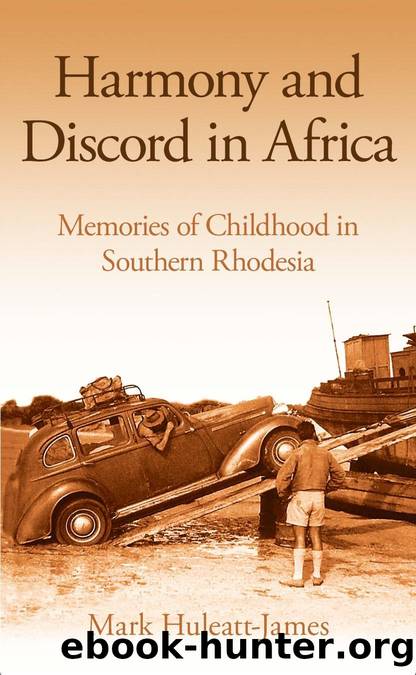
Author:Mark Huleatt-James [Huleatt-James, Mark]
Language: eng
Format: epub
Tags: Emigration & Immigration, Personal Memoirs, Social Science, Biography & Autobiography, Political Science, Middle East, Islamic Studies, History, Sociology, Colonialism & Post-Colonialism, General
ISBN: 9780857729231
Google: O-_KDwAAQBAJ
Goodreads: 26781723
Publisher: Radcliffe Press
Published: 2015-07-24T00:00:00+00:00
10
INDEPENDENT THINKING
The optimism which surrounded my arrival at Ruzawi was in part a reflection of the sense of well-being which infused the Europeans in Southern Rhodesia. Membership of the Federation had brought considerable economic benefits, and the Federation itself was soon to become the most industrialised area, excluding South Africa, in sub-Saharan Africa. National income rose by nearly fifty per cent and exports increased by almost seventy-five per cent in the first six years of the Federation. But the next few years were to see political and economic developments which would undermine European complacency.
At the end of the 1950s there was a reduction in demand for copper (the Federationâs principal mineral export) and in foreign capital inflows. Europeans were also made to realise that African aspirations to independence with majority rule were serious and achievable when the British colony of the Gold Coast became the independent state of Ghana in 1957. Early in 1959 there were riots in the Belgian Congo in support of independence which the Belgian authorities realised they were powerless to stamp out. The Congo obtained independence in July 1960 and got off to an inauspicious start. It was widely reported (in reports that have yet to be substantiated) that its first prime minister, Patrice Lumumba, ended his Independence Day speech by bluntly telling King Baudouin of Belgium that âNous ne sommes plus vos macaquesâ (We are no longer your monkeys). Within weeks of independence, Congolese soldiers mutinied against their European officers and the southern province of Katanga, which had the best of the countryâs mineral resources, seceded. The result was a vicious civil war. The United Nations sent some twenty thousand soldiers as peacekeepers in an attempt to restore order and protect the Europeans in the country. It did not succeed with either endeavour.
Streams of European refugees headed south, coming into Southern Rhodesia where, amongst other places, a reception centre had been established for them near Sinoia. My parents, along with other members of the Ayrshire community, sent blankets, clothes and food to it. The refugees came with their few possessions stuffed in their cars. Some even brought the bodies of loved ones killed in the violence. Lurid stories as to how terribly the bodies of those who had been killed had been mutilated were soon doing the rounds.
It was all, at the very least, unsettling for the Europeans living in Southern Rhodesia. It was a complete shock for many of them. The combined effect was to stunt the development of initiatives to increase the emancipation of the Africans and otherwise improve their lot.
The liberally minded prime minister of Southern Rhodesia, Garfield Todd, had tried to introduce reforms which would improve educational opportunities for Africans and increase the number of them who were eligible to vote. His cabinet rejected him as leader in 1958 and he was replaced by Edgar Whitehead. In the general election which followed later in the year, the principal issue was African majority rule. Toddâs new party, the United Rhodesia Party, failed to win a single seat.
Download
This site does not store any files on its server. We only index and link to content provided by other sites. Please contact the content providers to delete copyright contents if any and email us, we'll remove relevant links or contents immediately.
| Anthropology | Archaeology |
| Philosophy | Politics & Government |
| Social Sciences | Sociology |
| Women's Studies |
Cecilia; Or, Memoirs of an Heiress — Volume 1 by Fanny Burney(32559)
The Great Music City by Andrea Baker(32021)
Cecilia; Or, Memoirs of an Heiress — Volume 2 by Fanny Burney(31957)
Cecilia; Or, Memoirs of an Heiress — Volume 3 by Fanny Burney(31943)
We're Going to Need More Wine by Gabrielle Union(19050)
All the Missing Girls by Megan Miranda(16037)
Pimp by Iceberg Slim(14515)
For the Love of Europe by Rick Steves(14149)
Bombshells: Glamour Girls of a Lifetime by Sullivan Steve(14078)
Talking to Strangers by Malcolm Gladwell(13375)
Norse Mythology by Gaiman Neil(13372)
Fifty Shades Freed by E L James(13245)
Mindhunter: Inside the FBI's Elite Serial Crime Unit by John E. Douglas & Mark Olshaker(9345)
Crazy Rich Asians by Kevin Kwan(9295)
The Lost Art of Listening by Michael P. Nichols(7507)
Enlightenment Now: The Case for Reason, Science, Humanism, and Progress by Steven Pinker(7315)
The Four Agreements by Don Miguel Ruiz(6767)
Bad Blood by John Carreyrou(6624)
Weapons of Math Destruction by Cathy O'Neil(6283)
